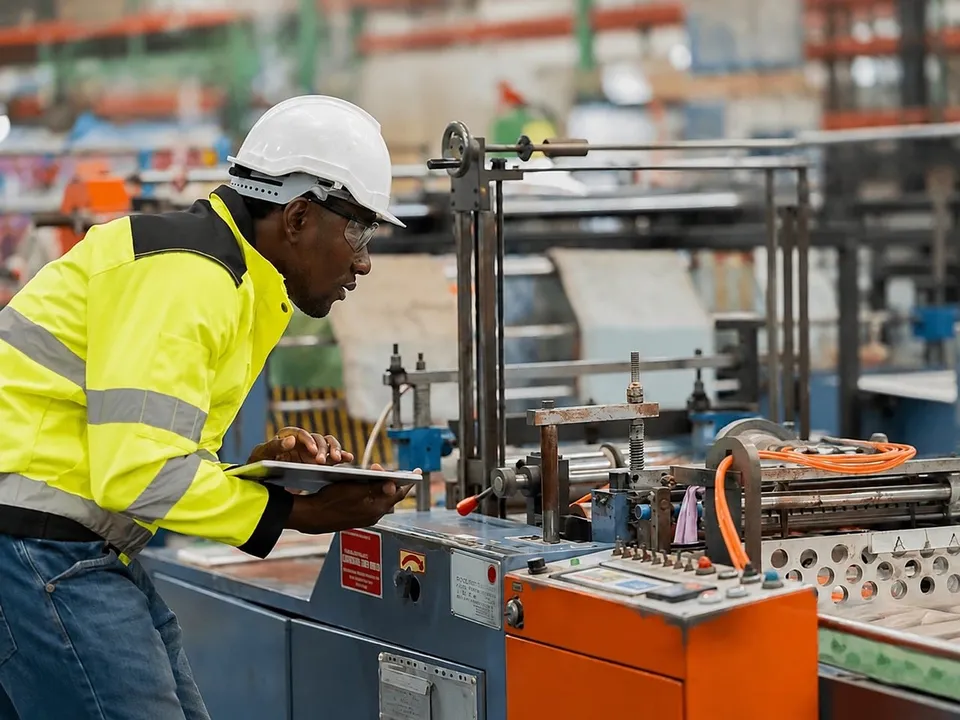
The same industrial title can point to three very different jobs. In a job shop, the day may revolve around setup changes and short runs. In a line, the pressure is pace, handoffs, and consistency. In a process plant, discipline around sanitation, temperature, and control can matter more than a fast hand. Federal job descriptions show why: machinists set up and operate machine tools and may program equipment, production supervisors plan schedules and assign sequences while keeping attendance and training organized, and quality control inspectors often work nonstandard shifts that can be tied to seniority.
Start with the production environment, not the title
A job shop asks for adaptability. O*NET describes machinists as workers who set up and operate machine tools, use mechanics and mathematics, and may program equipment to perform production tasks. The same source also shows that machinist labels can hide different realities: CNC machinist, maintenance machinist, production machinist, and tool-room machinist are not interchangeable roles. That is why a candidate from adjacent work may transfer well, but still need to prove tolerance, setup, and measurement skill on the actual equipment.
For employers, that means the strongest screening question is often not whether someone has industrial experience at all, but what kind of industrial experience it was. A person who has lived in short-run work may be very strong on changeovers, prints, and precision, yet not the best fit for a repetitive line that rewards rhythm and pace. A machinist who can troubleshoot a setup may be a great hire for one shop and the wrong hire for another if the second shop needs production volume more than one-off problem solving.
A line job rewards pace, handoffs, and stamina
A repetitive line or cell asks different questions. Here the useful evidence is less about unusual part problems and more about whether a worker can hold pace, communicate across handoffs, and show up reliably when the shift gets hard. BLS says quality control inspectors are concentrated in manufacturing and some work evenings, overnight, or weekend shifts; NIOSH adds that night work and extended hours can slow reaction time, reduce attention, and impair judgment. That is why a line job should screen for shift fit and fatigue tolerance, not just for general warehouse or assembly experience.
Ergonomics matters too. NIOSH notes that forceful exertion, repetition, lifting, vibration, and awkward postures can contribute to musculoskeletal strain. In plain English, a steady line job is not automatically easy just because each motion is simple. It may be physically demanding precisely because it repeats the same motion all shift. Employers who understand that usually do better when they plan tooling, rotation, and staffing around the body’s limits instead of treating soreness as a personal failing.
Process plants add a different kind of discipline
Process plants raise another question: what does the product tolerate? The federal descriptions remind us that supervisors in production settings are responsible not just for schedules and training, but also for enforcing safety and sanitation rules. That matters in regulated environments where contamination control, temperature discipline, and procedural handoffs are part of the work itself. A process operator who skips a step is not merely behind schedule; the batch may be affected.
That difference changes hiring. In a process environment, the worker who looks best on paper may still need a longer onboarding period if the facility uses strict procedures, special cleaning rules, or tightly defined handoffs between production and maintenance. The right candidate is not just competent with tools or machines. The right candidate is comfortable following sequence, reporting deviations, and respecting the process that protects quality.
Authorization is not the same as experience
This is where industrial hiring often goes wrong. Employers sometimes assume a warehouse background or a general production background is enough to cross into a more specialized job. OSHA says it is not that simple. Powered industrial truck operators must be trained and evaluated before they can operate the truck, and that evaluation must be repeated at least every three years and after refresher training. A person may have relevant experience, but the employer still has to confirm site-specific authorization.
Temporary staffing makes the distinction even more important. OSHA says staffing agencies and host employers share responsibility for training, hazard communication, and recordkeeping, so the question of who teaches what has to be settled before day one. That is especially important in industrial settings where the same worker may be fine for one task but not yet cleared for another.
Better questions lead to better fits
For employers, the useful hiring question is not whether someone can do industrial work, but which kind of industrial work. Start with these four checks:
- Is this job setup-heavy, operation-heavy, inspection-heavy, or maintenance-heavy?
- Which skills transfer from an adjacent role, and which require site-specific authorization?
- What shifts, overtime patterns, and fatigue risks come with the role?
- Who owns training if a temp or contractor enters the mix?
Those questions lead to cleaner job ads, more useful interviews, and fewer bad first weeks. They also create a fairer screen for applicants who may have the right base skills but need the right environment. Federal apprenticeship guidance reinforces that point by treating paid work, mentoring, classroom learning, progressive wages, and a portable credential as connected pieces of a real career pathway, not separate perks.
If you are rewriting a posting, start with the production environment before the title. A job shop, a line, and a process plant may all need reliable industrial people, but they do not need the same person in the same way. Employers can review the employer resources page, and job seekers can start with the job seeker resources page.